AutoRes_Math @AutoRes_Math
AutoResはAIによる自動研究を目指す有志団体です。 このアカウントではAI4Mathに関連する情報をまとめます。 Zenn: https://t.co/LB1yxbJzZT discord: https://t.co/DLdIHM7vhr autores.one/japanese Joined January 2026-
Tweets260
-
Followers47
-
Following123
-
Likes7
AI technology is on the rise. So are its applications in industry, science, and society at large. At leidendeclaration.ai we, a group of 16 scientists, including mathematicians, computer scientists, philosophers, and historians, have drafted a declaration calling for action on the challenges posed by the use of artificial intelligence in mathematical research. Over several months, we carefully weighed the promises and risks of introducing AI into research workflows and beyond. The declaration has already been endorsed by international communities, most prominently by the International Mathematical Union, as well as by a large group of mathematicians and other scientists. We invite our colleagues to sign the declaration and support its recommendations on how AI should be adopted in our workflows, and how we should establish and maintain relationships with AI labs and industry. One of its central points is the need to preserve balance, rigor, and sound judgment while acknowledging the extraordinary pace of development in the AI community. We hope this declaration, a deeply human act, will serve as a guiding document for those who recognize the human imperative and the need for governance in scientific discovery, especially mathematical discovery.
事例交換/技術的質問をする会を6/4 or 6/5で(東京 + online?多分...)でやる話になっているので,ご興味ある方はぜひ.
私が私のためにAI for Mathのニュースと道具を自動通知するdiscordサーバです。(広義の)数学者の皆さん、ぜひ このサーバへの投稿はclaude codeへ定期的に読み込まれるので、その点同意してから入ってください。 discord.gg/7zAGEY4EB

AI can give researchers the freedom to pursue “crazier” ideas. For Terence Tao, AI creates more room to experiment, test unexpected paths, and discover what might otherwise stay out of reach.
Today, we share a breakthrough on the planar unit distance problem, a famous open question first posed by Paul Erdős in 1946. For nearly 80 years, mathematicians believed the best possible solutions looked roughly like square grids. An OpenAI model has now disproved that belief, discovering an entirely new family of constructions that performs better. This marks the first time AI has autonomously solved a prominent open problem central to a field of mathematics.
If you are a mathematician, then you may want to make sure you are sitting down before reading further.

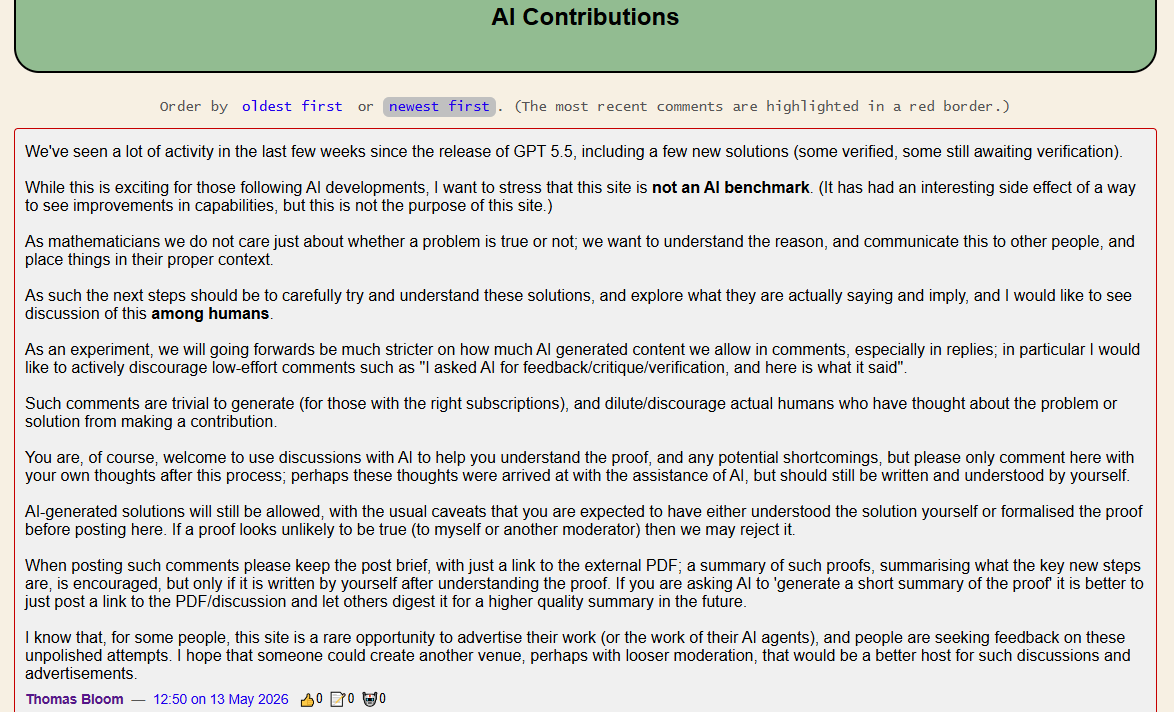
FYI, if you are submitting an AI-generated/assisted solution to an Erdős problem, please take the time to understand the argument enough that you should be able to distil the general ideas and be able to be happily questioned on said points. Also, ideally, write the PDF yourself.
生成AIで科学がどう変わるのか、気になりますよね…? 6/12(金)に研究会「生成科学:生成AI時代の科学の姿を探る」を開催します。物理・生命・数学など、分野をまたいで喧々諤々と議論します。 現地・Zoomのハイブリッドです。 sites.google.com/view/workshop-… 面白いと思いますのでぜひに。
For the last few months, we’ve been building a proving agent with the Numina Project. Recently, it found a proof of a conjecture in control theory that I had attempted to prove while a PhD student, and that I had not managed to solve. It had remained open since then (1/15)

Terence Tao: "Previously, you needed a PhD to contribute to math research. Now a high school student can." Dwarkesh asks the world's most famous mathematician: what's your advice for someone considering a career in math, especially in light of AI progress? Tao is honest about uncertainty: "We live in a time of change. A particularly unpredictable era. Things that we've taken for granted for centuries may not hold anymore. The way we do everything... not just mathematics... will change." He admits his preference: "In many ways, I would prefer a much more boring, quiet era where things are much the same as they were 10 or 20 years ago. But one just has to embrace this. There's going to be a lot of change. The things you study... some of them may become obsolete or revolutionized. But some things will be retained." On new opportunities: "Previously, you had to go through years and years of education and get a math PhD before you could contribute to the frontier of math research. But now it's quite possible at the high school level that you could get involved in a math project and actually make a real contribution... because of all these AI tools and Lean and everything else." His advice: "There will be a lot of non-traditional opportunities to learn. You need a very adaptable mindset. There'll be worth pursuing things just for curiosity and for playing around. Still go through traditional education and learn math and science the old-fashioned way for a while... credentials will still be important. But you should also be open to very, very different ways of doing science. Some of which don't exist yet." He concludes: "It's a scary time. But also very exciting."

【数学の未解決問題 AIが相次ぎ解く】 news.yahoo.co.jp/pickup/6578584
I think a radical new viewpoint is emerging on the many activities that mathematicians do. Perhaps a novel profession of mathematical engineering is emerging from the early chaos of AI for mathematics. I can see very clearly that the coordination, setup, technical pursuit, and orchestration of AI systems scaled for massive mathematical efforts and projects will require a special engineering mindset that is currently lacking, or almost completely absent, in mathematical projects. The existence of such a profession is not in opposition to mathematical tinkerers who use their artisanal craft to produce genuinely novel content. As with any kind of content, someone needs to adapt it to the grand scheme of things. This is why these roles are starting to appear complementary rather than competitive. Maybe this is a temporary activity, soon to be replaced by computers, but I think the major role of mathematical engineers will be to stay in touch with the tinkerers and provide a human cushion around their internal activities. I am enjoying this kind of activity (*), where you orchestrate with models and see how the project itself becomes a challenge in design and scale. This might well mean more jobs for mathematicians. In the long run, I suspect we may become secondary cognitive powers in parts of the mathematical information chain. But I do not think this will happen very soon across the whole system. And I hope it never happens at the most human layer: the joy people feel when a new idea is born. (*) This project is essentially a lambda-calculus lab, fully integrated with classical topics such as Church’s lambda calculus, the Aristotle formal proofs system, and extensions over particular papers. I presented it to students at the workshop in Warszawa-Falenty and was very pleased with the result. I am now using this framework for proof development. What strikes me most is that this is primarily an engineering challenge: the mathematics entering the pipeline is being handled, structured, and formalized, but not radically developed inside the pipeline itself.


エルデシュ問題#514の第3問について自然言語証明と形式化を行いました。フォーラムのステータスが partial から solution になっているため、じきに OPEN から PROVED に変わるのではないかと思います。githubの方でも名前が載りました。 erdosproblems.com/forum/thread/5…


【論文発表のお知らせ】 「Lean Atlas: An Integrated Proof Environment for Scalable Human-AI Collaborative Formalization」がAIPV2026に採択されました。 arxiv.org/abs/2604.16347 AIが生成する形式数学証明、その「意味」は誰が保証するのか? 私たちは、AIが証明を、人間が意味を、定理証明器が論理を担うという役割分担を提案します。 定理証明支援系の型検査が保証するのは、命題に対して証明項が論理的に正しく構成されていることのみです。 命題のステートメントや定義が意図された数学的内容を表しているかは検証されません。 本稿ではこのギャップを意味的ハルシネーション(semantic hallucination)と定義しました。 AIが「3/2 = 1.5」をLeanに書き起こす際、型注釈を落とすと自然数として解釈され、「3/2 = 1」という命題が型検査を通過し証明まで完結してしまう、こうした「論理的には正しいが意味的には誤った」形式化が、AI生成証明には潜みうるのです。 これに対して私たちは、Lean4プロジェクトの依存グラフを型依存と値依存に分けて可視化する対話型WebビューアLean Atlasを開発しました。 中核となるアルゴリズムLean Compass は、証明の論理的正しさにだけ関わる依存を安全に取り除き、定理の意味に影響しうる部分だけを残します。 これにより、人間が意味的にレビューすべき範囲を大幅に絞り込めます。数千ノード規模のプロジェクトでも、人間がレビューすべき範囲が劇的に絞り込まれます。 構造の異なる6つのLean4プロジェクト(PrimeNumberTheoremAnd、Carleson、Brownian Motion、FLT、PhysLib、XMSS Encoding Scheme)で評価しました。 証明中心のプロジェクトでは平均94–99%のノード削減を達成しました。 最大規模の Carleson では2,000ノード近い依存グラフが5ノードまで縮小される例も観測されています。 さらに理論物理学(PhysLib 69.0%)と耐量子暗号(XMSS 27.3%)にも適用可能であることを示し、本フレームワークが純粋数学を超えた科学分野の形式検証にも展開できることを実証しました。 私たちは、人間による意味的検証を経た形式化コードを意味整合的Leanコード (aligned Lean code) と定義し、AI生成形式化の新たな品質基準として提案しています。 型検査の通過率では捉えられない「意味的な正しさ」を、AIと人間が分担して保証し、その人間側の負担を実用的な規模まで圧縮する基盤がLean Atlasです。 意味整合的Leanコードを蓄積することで、AI の学習データおよび数学者の参照資源として機能する形式化コードベースを築く、これが私たちが目指す human-AI 協調形式化の未来像です。


Why Agentic Theorem Prover Works: A Statistical Provability Theory of Mathematical Reasoning Models ift.tt/C51sXAj
GPT-5.5 Pro is really on the next level. In the past 3 days there are like 8-10 claimed solutions to new open Erdos problems with GPT-5.5. That doesn't mean all are valid and will be accepted, but the last time we had a similar activity was in December/January with GPT-5.2 (and even then there was less claims and not as fast). Also these claims right now are for harder problems, because all Erdos problems were scanned with GPT-5.2 at least briefly. This means that GPT-5.5 is a level above 5.2, and probably half a level above 5.4. Solutions that surface are more involved/interesting. I've browsed a couple and they all seem plausible. 5.5 got considerably better at synthesis of various arguments from various sources and doing it in a more effective way. I'm pretty sure we're going to see even more spectacular applications soon. However we're still pretty far away from AI being at a proper research-level. My move 37 in mathematics would actually be a new definition, not a proof. I need to see an LLM define a new concept that would simplify or connect various existing structures and give raise to a new theory. But perhaps this would be synonymous with AGI.
I've been testing GPT-5.5 Pro since its release 2 days ago and here are some thoughts: - it's definitely different, probably better but in non-obvious ways - it's harder to make it think longer than 10-15 minutes, though I've managed to get it think for 50-60 mins a couple of

Great to see Lean at the centre of this closed loop: from autonomous discovery, to formal verification, to mathematical exposition that humans can read, rewrite, and improve.

To my mind, what seems most important here is not so much the results themselves, nor even the particular methods used in the proof. What really matters is the workflow: the closed loop from autonomous discovery of the right constructions, to formal verification of the proof in
2026/4/28 テレンス・タオ氏の投稿まとめ 数学は「証明の希少性の時代」から「証明の豊富さの時代」へと移行しているが、数学のインフラと文化はまだそれに適応していない。 1. 三つの構成要素のインピーダンス・ミスマッチ 数学的問題解決には3つの段階があり、AIによって最初の段階だけが急加速したため、不均衡が生じている。 ・証明の生成(proof generation): AIにより爆発的に増加 ・証明の検証(proof verification): 追いついていない ・証明の消化・理解(proof digestion): 追いついていない 具体例として、エルデシュ問題サイトでは、GPT-5.5のリリースとエルデシュ問題#1196の解決以降、評価待ちの主張された解答が約20件も滞留している(以前は常時1〜2件程度だった)。 2. 料理のアナロジーによる説明 タオ氏はこの状況を「食料」に例えて説明している。 < 数学と料理の対応関係> - 証明の生成 → 食料の収集 - 証明の検証 → 食料の洗浄・検査 - 証明の消化 → 調理 食料が希少な社会では、食料を持ち込む狩人・農民が最も称賛される。どんな素材でも歓迎され、誰かが調理を引き受ける。 食料が豊富な社会では、見知らぬ人が処理されていない肉の塊を持ち込んでも歓迎されない。よく調理され、信頼できる人が作った料理が重視され、その周りでの会話や次世代の育成が大切にされる。 3. 逆説的な現状 証明生成が大幅に加速したにもかかわらず、数学の進歩自体は加速していない。なぜなら、AIに指示を出した人が「検証や要約をする時間がない」ままの「生の」証明が大量に投下されているから。 こうした貢献は問題への議論を実質的に進めないだけでなく、「もう解かれた」と見なされて問題への関心を逆に殺してしまうという負の影響すらある——たとえ誰一人としてその解を理解していなくても。 4. タオ氏の予測と提言 - 証明を最初に生成したことに対する名声の一部は、検証・消化を担う人々へ移転される必要がある。 理想的には、生成・検証・消化を同じ著者グループが担うべき。 - 現代社会が生の食材を「食事」と見なさないのと同様に、数学界も「生の」「未消化の」証明を「問題の解答」とは見なさなくなるだろう。 - 重要なのは個別の問題の解決そのものではなく、分野全体がその貢献によってどう豊かになるかである。
Ramsey numbers are one the most basic objects in combinatorics, a beautiful illustration of structure within chaos. They have been heavily studied for almost a century now, so it came as a real surprise to us when an internal version of GPT-5.5 proved a new elementary result about them: \lim_{n\to \infty} R(k,n+1)/R(k,n) = 1 for all k This was also known as Erdos problem #1014, although I personally think the more relevant bit is that it's a basic result about off-diagonal Ramsey numbers. As it often happens (for now), the proof is reasonably simple in hindsight, although it is quite a wire act and it relies on some unexpected numerics (the "unexpected" part here is probably why this wasn't discovered before). Despite being simple, it's certainly the type of result that could now be taught in a combinatorics class. Pdf of the proof (produced by @mehtaab_sawhney): cdn.openai.com/pdf/6dc7175d-d… Lean verification of the proof (produced by Boris Alexeev): github.com/plby/lean-proo…

The Lean language (@leanprover) has utilities for verifying software, and AI is adept at using it. But can AI prove correctness for a *foreign architecture* with *no existing API*? It turns out, yes! @HarmonicMath's Aristotle wrote a z80 emulator: github.com/Timeroot/Z80Emu (1/n)

faye @MariaChantzi
171 Followers 123 Following 30代で半FIREを達成し、自由な時間を楽しんでいます。お家時間を心地よく過ごすためのヨガや、日本語の勉強が最近のルーティン。投資はこれからの未来に向けた淡々とした記録です。等身大の日常をゆるっと呟きます。
あかげふ @juvenile_crimes
1K Followers 125 Following Derivative operator ∂ is all I need. Dream: quantum groupoid invariant of knots and 3-manifolds Developping M3E(Mind Map Model Engine)


Yuki Minoh | 状況�... @AlphaMinaph
309 Followers 596 Following 人間の知性に関心がある〈修士(メディア表現)〉 博士後期課程への進学準備中...... --- IAMASを卒業して学際性を運命付けられたフリーランスエンジニア。 IAMASを「『状況に埋め込まれた他者』との対話」で卒業しました デザイナーの認知プロセスを研究しています
日比野 啓 (Kei Hi... @khibino
2K Followers 2K Following Haskellプログラマ. 開発中のDNSフルリゾルバ他: https://t.co/8j8HEZukgW 型検査されたSQLを生成するDSL: https://t.co/GIFgbQBG6H kw: 関数プログラミング,DNS,形式検証
ShinShin @nk121811
45 Followers 241 Following
サオトメ @unagi_sagari
11 Followers 197 Following
R @sinks_04
0 Followers 5K Following
bᵃᵇᵃ @hoichoipd
31 Followers 1K Following e/acc proponent Scaling towards AGI, one parameter at a time
Günther | グンタ @gunta85
6K Followers 5K Following AI - Design - Engineer | JP⇄EN Built OpenSTF (GitHub 13k+★)
Y.nabe @YNabe_AI
1K Followers 1K Following シンギュラリティ前後の世界を考える日々。ex-Amazon@Seattle / PhD in ML / 医学を勉強中。東京→京都→Seattle→Honolulu→Austin→東京

Dan @danpaleta
135 Followers 2K Following
mz @mz30095060
3 Followers 38 Following
pyonpyon @pyonpyo40617688
22 Followers 2K Following

イカ @w_exkhamjgfy
1K Followers 5K Following
Chikara Oe @FifthForce_
487 Followers 1K Following Physics @tohoku_univ, On exchange @UCBerkeley, research @ATLASexperiment LaboRobo lnc. Reprogramming the Multiverse 🚀 DM👌
富谷(AI×物理)/�... @TomiyaAkio
11K Followers 2K Following 素粒子理論物理学者(格子QCD×機械学習)。著書 https://t.co/TMHGxz6pyO 准教授, 学変A(計画班代表), 基盤B(分担),基盤C(代表) 🐉🍕 #シン・仮面ライダー 人工知能監修, 博士(理学),サマチャレ2期
クマムシ.exe @SugarHigh_bin
379 Followers 6K Following


ymzkey @ymzkey
630 Followers 2K Following 興味:LLM/AIエージェント/ローカル推論/LoRA/RAG/GAS/Python/論文(arXiv)/計算機シミュレーション/DTM/動画編集/Blender/イヤホン 仕事:施工管理(電気・通信)/エッジコンピューティング/産業ロボット/シミュレータ構築 気軽に話しかけてください。

Koukyosyumei @Koukyosyumei
673 Followers 841 Following CS PhD @Columbia Researching AI agent security, software system, and verification Building https://t.co/YvZN7rKzvb for AI-generated code provenance ex-@apple intern
climbing lane @LaneClimbing
0 Followers 121 Following
Leona 極度妄想(... @leo_hio
16K Followers 2K Following 暗号を微妙に齧ってます。Intmax( @IntmaxIO) 共同創業・主任, seccamp, チューリッヒ大夏期講師 En: @HiokiLeona


Toma Tanaka @fuyu_quant
1K Followers 888 Following NexaScience Inc. Cofounder & CTO AI for Sciece、Data Science、AutoRes https://t.co/tM2fzrgbKf (AI研究の自動化PJ) 著書:先輩データサイエンティストからの指南書
夜の窓 @Awaken_MyLove_
708 Followers 2K Following 興味→機械学習/生命科学/映像/bio,chem,material-infomatics/Lab Automation,Autonomous Lab/AI for science;
Shiro Takagi @takagi_shiro
2K Followers 2K Following 研究ができるAIと、それを前提とした新しい知識生産システムに興味があります。 https://t.co/3QYCqcpzfN ENG: @46takagi
田村俊樹 @tAmutAmu33333
137 Followers 78 Following
IMP@事故災害のAI... @imp_AI_Sec_Lab
119 Followers 77 Following IMP AIセキュリティ研究所は最先端研究の社会実装を目指します。 動画生成AIで可視化する事故災害: https://t.co/fbUsN01yaV youtube: https://t.co/RPArj6qc7Z 漫画: https://t.co/WdymuxNu6o 技術ブログ: https://t.co/psuFh2xM0v
Genki Kanda @Kd_Gn
3K Followers 625 Following 東京科学大学 教授 / 研究や実験を自動化するための研究をしています → https://t.co/odWbyt3Pd0 / 自動化の情報収集はこちらの研究会がおすすめです → https://t.co/nBRe9aCRMp
Yasushi @yasushikeda
24 Followers 299 Following

Daceat @Daceat994
46 Followers 1K Following
秋霜ひさめ @akishimo_hisame
232 Followers 3K Following 関東のとある大学の学部生、数学/情報系、創作もやってます/サークルGALEXSOFT(@galex_soft)Unity/Naninovel使ってます 興味:LLM、機械学習、数理論理学、自動定理証明、LEAN、AI4Math


rsaigpm @sdkumatw
0 Followers 4K Following
不自然対数 @study_unnatural
4K Followers 3K Following AI・バイブコーディング、数学 、株式投資、就活およびキャリア/ 理系院 / アマゾンアソシエイト参加中 / ブルバ80くらい(エロ・無断転載系除く)
折池雄太 @YutaOriike
181 Followers 492 Following Automated Scientific Discovery / AI / Robotics AI4Math情報まとめ: @AutoRes_Math
Yutaro Yamada @_yutaroyamada
838 Followers 448 Following Research Scientist @SakanaAILabs working on AI Scientists & LLM agents. Past: PhD & BS @Yale. ex-intern @allen_ai @ai2_mosaic, cyberagent AI lab, @Meta

Ryuya Hora @hora_math
158 Followers 142 Following English account of @hora_algebra / the University of Tokyo / Category theory
Xiao@ZEN大学数学�... @lim_longbao
782 Followers 2K Following 新B2/06(05)/NITGC→@univ_ZEN 表現論/圏論(ACT)/量子情報/自然言語処理/数理論理学/理論言語学/言語哲学
あかげふ @juvenile_crimes
1K Followers 125 Following Derivative operator ∂ is all I need. Dream: quantum groupoid invariant of knots and 3-manifolds Developping M3E(Mind Map Model Engine)
渡邉究/数学科�... @Kiwamu_Watanabe
12K Followers 1K Following 中央大学理工。代数幾何。すごすぎる数の図鑑:https://t.co/jpAeKfGmKz 数学YouTube:https://t.co/NfanAGVR0k サブアカ@KiwamuWatanabe2
ほら/hora @hora_algebra
3K Followers 720 Following 数学の研究をしています. いろいろ、特に数学のいろいろ、特に圏のいろいろ、最近は特にトポスやcoalgebraのいろいろに興味があります R.Hora/ category theory/ @hora_math
数理空間“τόπ... @mspacetopos
4K Followers 113 Following 学校で学ぶ範囲を超えた数学を主体的に勉強する中高生のための場、数理空間“τόπος” のアカウントです。 開室時間は毎週土曜日15:30~19:30、お問合わせは [email protected] までお願いいたします。 意欲的な中高生の皆さんのご参加をお待ちしております。

Alex Meiburg @Timeroot
255 Followers 386 Following Quantum info, Magic the Gathering jokes, and whatever else. | Postdoc @ UWaterloo IQC, Perimeter Institute.
Alex Lupsasca @ALupsasca
5K Followers 127 Following Research Scientist @OpenAI & Assistant Professor @VanderbiltU. Black holes, photon rings, gravity & beyond. Formerly @Harvard and @Princeton.
Jess Riedel @Jess_Riedel
3K Followers 1K Following Quantum info & foundations @NTTResearch. Fueled by loathing of bad explanations. Seeking a rigorous definition of classical branches in many-body wavefunctions.
Sebastien Bubeck @SebastienBubeck
77K Followers 1K Following I work on AI at OpenAI. Former VP AI and Distinguished Scientist at Microsoft.
Mira @_Mira___Mira_
11K Followers 2K Following
Fabian Gloeckle @FabianGloeckle
1K Followers 304 Following PhD student at @AIatMeta and @EcoledesPonts with @syhw and @Amaury_Hayat, co-supervised by @wtgowers. Machine learning for mathematics and programming.
Przemek Chojecki | PC @prz_chojecki
12K Followers 1K Following Math Data + Evals + Models @ https://t.co/v2xNrVTykE, PhD in mathematics
Mehtaab Sawhney @mehtaab_sawhney
3K Followers 6 Following
SIAM Activity Group o... @DynamicsSIAM
12K Followers 1K Following The X account of Society for Industrial and Applied Mathematics activity group on Dynamical Systems. Managed by activity-group officers. https://t.co/StVrDaPXwb
Ziran Yang @__zrrr__
472 Followers 615 Following PhD student @Princeton, BS @PKU1898 Looking for verifiable reasoning
Koukyosyumei @Koukyosyumei
673 Followers 841 Following CS PhD @Columbia Researching AI agent security, software system, and verification Building https://t.co/YvZN7rKzvb for AI-generated code provenance ex-@apple intern
Mohammed Alshehri @SwishMoe
581 Followers 2K Following 23 | Applied ML\RL, Post Training → building and learning prev @ibmwatsonx
Ashvin Swaminathan @aaswaminathan01
1K Followers 227 Following Benjamin Peirce Fellow @Harvard. PhD @Princeton. Intern at @axiommathai. Excited about building the bridge between pure math and AI.
Bartosz Naskręcki @nasqret
11K Followers 422 Following Mathematician | Vice-Dean @UAM_Poznan | Researcher @ccaiwut | Owner of https://t.co/lEspgf36Pg | Mathematics, AI and programming
UMD Department of Com... @umdcs
7K Followers 90 Following Official feed for the @UofMaryland's Department of Computer Science housed in the @iribecenter.
Mohammad Hajiaghayi (... @MTHajiaghayi
2K Followers 126 Following Minker Professor of CS, ACM Fellow, Guggenheim Fellow,AAAS Fellow, Blavatnik Honoree, IEEE Fellow,EATCS Fellow working on Algorithms, Game Theory and BIG Graphs
Enrique Barschkis @ebarschkis
2K Followers 364 Following Cryptography hobbyist, Master and Commander
Ernest Ryu @ErnestRyu
10K Followers 388 Following Assistant Professor at UCLA, Department of Mathematics. Research Scientist at OpenAI.
Kimon Fountoulakis @kfountou
4K Followers 121 Following Associate Professor at CS UWaterloo Machine Learning and AI Lab: https://t.co/Yrb5b8lwrT
Quanquan Gu @QuanquanGu
25K Followers 2K Following Professor @UCLA, Ex-ByteDance Seed | Recent work: Seed2.0, SeedFold, SeedProteo | Opinions are my own
Julian Salazar @JulianSlzr
1K Followers 638 Following Staff Research Scientist @GoogleDeepMind Frontier AI. Audio LMs (Gemini, Magenta RT) & AI for math(.AG, .NT). Past: #NLProc #SpeechProc @AWSAI, @HarvardMath.
Richard C. Suwandi @ ... @richardcsuwandi
1K Followers 983 Following PhD-ing @cuhksz. Co-organizing the first dedicated conference for AI-driven algorithm discovery @AIDDA_institute. Co-developed OpenEvolve, Kai @driaforall
Eliot Eshelman 🤖�... @hpc_twit
663 Followers 2K Following Accelerating scientific AI platforms @NVIDIA. From muons to bacteriophages to astrophysics. Opinions my own. he/him #Inclusion
Shang Zhu @ShangZhu18
298 Followers 319 Following AI Researcher at Together AI @togethercompute | alumni of @UMich @CMUEngineering and Xi'an Jiao-Tong University, China Opinions are my own.
Jeff Morris Jr. @jmj
120K Followers 4K Following GP @chapterone: @supabase, @mercury, @ereborbank @gen_intuition @Mach_Industries, @ether_fi, @OndoFinance. Building the most product-obsessed venture firm.
Alex Gu @minimario1729
5K Followers 2K Following founding researcher @mathematics_inc / mit phd student (on leave) / prev intern @ meta, nvidia, aws, jane street / enjoys 🎹✈️⛷️⛵
Davis Brown @davisbrownr
675 Followers 859 Following Research in science of {AI security, safety, DL}. PhD student at @Penn & RS at @PNNLab

Jasper Dekoninck @j_dekoninck
3K Followers 132 Following PhD Student at ETH Zurich, working on mathematical evaluation of LLMs (MathArena, IMproofBench, BrokenMath, ...)


Leonardo de Moura @Leonard41111588
7K Followers 29 Following
Jesse Michael Han @jessemhan
5K Followers 636 Following @mathematics_inc // prev. research @OpenAI 'turboautist' 'only guy i know who talks like an anime character'
Masaya Taniguchi @ma38taniguchi
83 Followers 40 Following 数理言語学 (数理論理学/ 形式言語理論)が専門です。 理化学研究所 自然言語理解チーム (TohokuNLP) 基礎科学特別研究員 博士 (情報科学) (JAIST) 好き: LISP / Prolog
Auguste Poiroux @augpoi
165 Followers 158 Following AI4Math & Autoformalization - PhD Student @EPFL - Founding Research Engineer @mathematics_inc
MiroMindAI @miromind_ai
3K Followers 193 Following Building a reasoning-first AI system, provably right for the highest-stakes problems.
富谷(AI×物理)/�... @TomiyaAkio
11K Followers 2K Following 素粒子理論物理学者(格子QCD×機械学習)。著書 https://t.co/TMHGxz6pyO 准教授, 学変A(計画班代表), 基盤B(分担),基盤C(代表) 🐉🍕 #シン・仮面ライダー 人工知能監修, 博士(理学),サマチャレ2期
Hayata Yamasaki @HayataYamasaki
1K Followers 340 Following 量子計算・量子情報を専門に研究しています。Working on the theory of quantum computation and quantum information. Associate Professor in Dept. of Computer Science, University of Tokyo
Tosho Hirasawa 🍉 @toshohirasawa
433 Followers 668 Following TMU (Ph.D.) ➜ Omron Sinic X, NexaScience ➜ LayerX / NLProc / 猫
Lexaaa @DayShuai
944 Followers 141 Following https://t.co/5Bx4vx5g8o ZJU - UCSD visiting - comp bio PHD student @NUSingapore | AI-NativeTrends for United States
You might like