Digital Impact Lab @DigImpactLab
Intelligence on Iran's digital operations. Cyber, influence, sanctions evasion, network infrastructure. Washington, D.C. digitalimpactlab.com Washington, D.C. Joined April 2019-
Tweets83
-
Followers44
-
Following0
-
Likes1
@markpash Most of our sources are inside Iran, so we redact all individual social media users by default regardless of location. It's a protective measure. On the citation: the source for that section was your tweets directly, not the article.
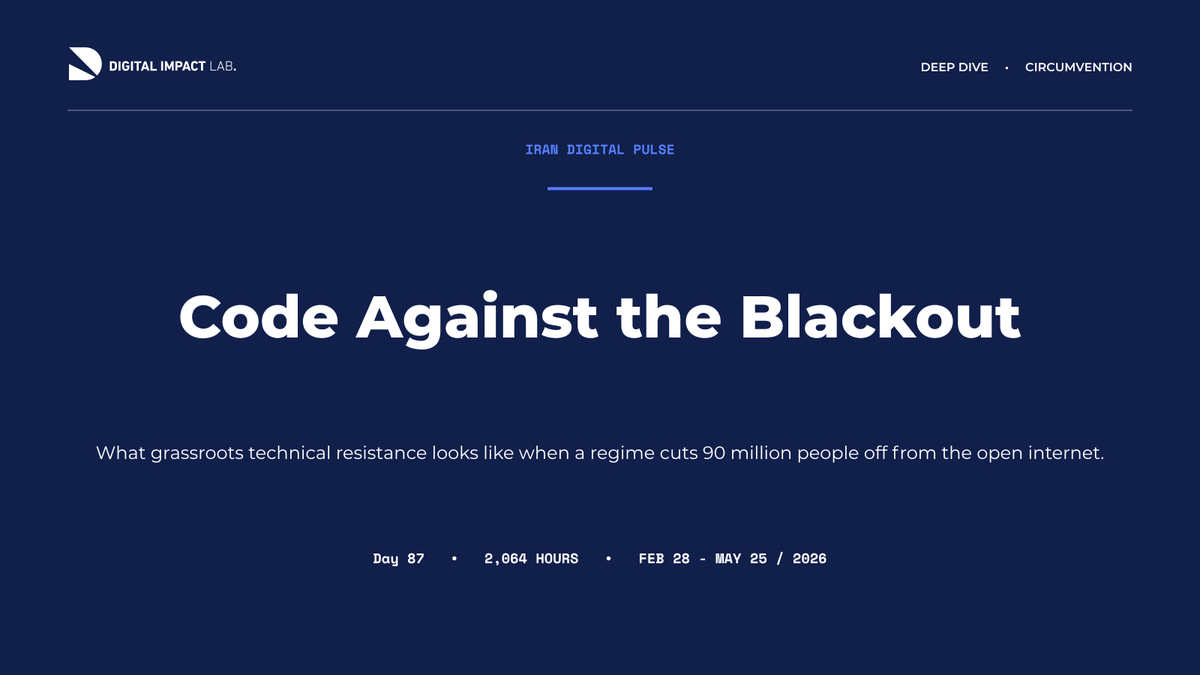
Iran’s internet blackout has a structural gap. The state blocked most of the international internet. It left Google’s infrastructure accessible. Within weeks, the Iranian technical community had built an entire circumvention ecosystem out of that exemption, on GitHub, distributed free.
@markpash @AminSabeti Thanks for the note. @mahsanet's analysis is cited and linked in the full piece; it's one of our primary sources. The thread format doesn't carry footnotes, but the article does. MahsaNet also shared our report on their own account, which we appreciated.
When Iran's internet came back on May 26, Cloudflare's data showed something unexpected: Iranian users were appearing to the global internet as Azerbaijani. Not a glitch. Not a VPN. Infrastructure. digimpactlab.substack.com/p/traffic-laun…

The Cloudflare Radar spike is timestamped to May 26, the exact day Iran's internet was partially restored. It doesn't look like infrastructure assembled after the restoration. It looks like infrastructure waiting to be switched on. Full analysis: digimpactlab.substack.com/p/traffic-laun…
This isn't improvised. Iran's state backbone operator (TIC) signed a formal strategic agreement with Delta Telecom CEO Ramazan Valiyev in April 2025. The routing is consistent across ISPs because it happens at the backbone level.
The government did not liberalize. It abandoned a monetization scheme (Internet Pro) that failed to achieve public adoption, restored the filternet that existed before January 8, and claimed credit for the restoration. The laws and infrastructure that made 88 days possible are unchanged. Full analysis: digimpactlab.substack.com/p/iran-digital…
Data centers tell the same story. An operator who tested Pishgaman, Afranet, and Sefroyek the day after restoration: “Most data centers still have no connectivity… Our servers still have no ping to foreign servers.” Infrastructure for circumvention remains under pressure by design.
Iran’s internet is back. Sort of. After 88 days of near-total blackout, Cloudflare Radar confirmed traffic restored to 40% of pre-shutdown levels on May 26, with 91.6% of that concentrated in Tehran. Provinces outside the capital remain near blackout conditions. A thread.


Iran may be moving beyond temporary internet blackouts toward something more durable: a Chinese-style system of digital control. iranintl.com/en/202605264373

The Internet Filtering Committee updates its filters. The developers release a new version. Each iteration: an institution with significant resources and enforcement power vs. individuals working in their spare time, in public, for free. Full analysis: open.substack.com/pub/digimpactl…
Iran has over 70 million internet users. The vast majority have no technical background and no means to pay for commercial access. A handful of engineers, in public repositories, are maintaining the primary non-commercial pathway to the open internet for a country the size of France and Germany combined.


Reza @reza6487sr
1 Followers 152 Following Everywhere: @reza6487sr Passionate about wedding photography, beauty shoots & color grading 📸
Mohammad YS @MammadYou2
38 Followers 469 Following

Vetiver @Vetiverrr
171 Followers 905 Following وطن داستان کسانیست که ترس را میترسانند و مرگ را به کام مرگ میکشند. ما کسانی هستیم که قبل از آنکه مرگ به سراغمان بیاید، برای وطن میمیریم. ☼𓃬 0505
Arash @Arash2042
29 Followers 159 Following
آستانه @haganiam0425
37 Followers 716 Following

Anonymous Source @AnonymyS19706
2 Followers 58 Following

Abbas Husseini @Husseini67
4 Followers 107 Following
bagwell @bagwell_teabag
173 Followers 1K Following
madrid22 @madrid270956186
30 Followers 497 Following
Arman Torkzaban @armantorkzaban
866 Followers 923 Following جمهوری دیجیتال برای ایران @JomhoorOrg Co-director @TransCF ریتوییت، گفتگو و … نشانهی تایید تمام مواضع طرف نیست؛ اکانت شخصی
###paric*** @_____rich______
335 Followers 6K Following

Armita Nemati @armitanemati
2K Followers 2K Following Verified videos from Iran @vahid @IliaHashemicom, Verified news @iranintl_en Oposition leader @pahlavireza building @pitnuclub

Amir @Amir33656253
4 Followers 2K Following


𝐸𝓍𝟥𝓅𝓉�... @Ex3ptionaL34
62 Followers 237 Following و آن کس که نمیدانست برای کدامین غمش گریه کند،قهقهه زد ... @Rapid7 Contributor
Mark Pashmfouroush @markpash
15K Followers 1K Following ex- Cisco,Isovalent,Cloudflare کدنویس شبکه، کرنل و سیستمهای توزیعشده فارسی زبان متولد انگلیس
Cameran Ashraf, Ph.D.... @cameranashraf
1K Followers 2K Following Human Rights @Wikimedia / Co-founder of @accessnow / Founder @AzadiArchive / Former #humanrights professor @CEU "Joy is not made to be a crumb" -Mary Oliver
Erick Diffin @Erickdiffin
33 Followers 215 Following
FDD's Iran Program @FDD_Iran
13K Followers 3K Following Featuring @FDD’s analysis on #Iran’s global threat network, nuclear & missile programs, politics, economy, human rights, sanctions, Iran-backed terror & more.
MW @mwlon
328 Followers 5K Following Professional alien, West London. Hats give me a headache but needs must...
guignolsumpen @no33223002
30 Followers 1K Following

Negin Soleyman @NeginSoleyman
769 Followers 5K Following
Mozhdeh @EyeonIRN_PAK
105 Followers 242 Following Researcher| Focus on Iran & Pakistan| COI| RT's and links are not endorsements| Views are my own Quality news about Iran & Pakistan
Kevin @Kevin28080758
0 Followers 4K Following
TypeError: undefined ... @unusedfunction
198 Followers 1K Following Front-end Developer close to the clouds☁️ 🤘🧟♂️🤖👨💻🐧🐳☕📖♟
loibarber @loibarberz
13 Followers 600 Following
Hamed SHEIBANYRAD @HSheibanyrad
7K Followers 1K Following President of Iran Novin Party دبیر نخست حزب ایران نوین @IranNovinParty https://t.co/DMB4YWSu0V

Arslan @alp_arslan2000
293 Followers 2K Following
Sina Roozbahani @__sina77__
869 Followers 4K Following @Telegram + @Clubhouse Professional Beta Tester (iOS) 👨🏻💻 "Technology Geek" 👨🏻💻 Computer Engineering👨🏻💻Creator of @TechWithSina TG Tech Channel 🙂🙃

Amin Sabeti | امی�... @AminSabeti
79K Followers 1K Following Infosec, Intelligence Analysis, Hunting Iranian State-Backed APTs, Founder @Certfalab, @DigImpactLab 📧 [email protected]Trends for United States
You might like