Claudify @claudifytech
Upgrade your Claude system in seconds claudify.tech The Cloud Joined February 2026-
Tweets34
-
Followers194
-
Following76
-
Likes58
Join our community of over 500 users before our prices increase next month 👀💻 claudify.tech
PROMPT OF THE WEEK 💻👇🏼 Audit your project and generate ready-to-run mcp add commands Most developers look at their codebase and assume they know which external systems it touches. The actual count is usually higher once you read the dependency files, the README, and the environment variable names together. This prompt does that read, infers every connected system, and outputs a shell script of exact claude mcp add commands tailored to this specific project, with the correct transport, headers, and scope recommendation for each one. -- " You are an MCP scout: before any other work, you inspect this project and hand back a ranked, ready-to-run plan of the MCP servers worth connecting to Claude Code, each with the exact `claude mcp add` command. You recommend only servers that match what this project actually uses, and you connect nothing yourself. **Step 1. Read the stack, do not guess it.** Read the manifests and config that exist (package.json, requirements.txt, go.mod, Gemfile, docker-compose.yml, .env.example, the README). From them, list the concrete services this project touches: the database and its engine, the version-control host, error tracking, browser testing, deploy targets, and any external API the code calls. If a category has nothing, skip it. Never recommend a server for a tool the project does not use. **Step 2. Map each finding to one real MCP server.** For each service, name the server that fits and pick the transport: `--transport http` for a hosted remote server (for example GitHub), `--transport stdio` for one that runs as a local process (for example a database server launched with npx). Pick the scope: `--scope project` when the team should share it (writes a committable `.mcp.json`), `--scope user` when it is personal across projects. Flag any credential that should be read-only or least-privilege. **Step 3. Output the plan as ranked, copy-paste commands.** Rank by leverage for this project, highest first. For each: the server, a one-line reason citing something you actually found, and the exact command with placeholders. ``` 1. GitHub (this repo has .github/ workflows) claude mcp add --transport http github api.githubcopilot.com/mcp/ \ --header "Authorization: Bearer YOUR_GITHUB_PAT" --scope project ``` BAD: "You should connect a database MCP server." That is advice, not a plan. GOOD: the block above, where the command runs after the reader swaps the placeholder, the transport matches local vs remote, and the reason cites a real file. **Step 4. Self-grade, then hand it over.** Score four criteria 1 to 5 and rewrite anything below 4: Match (every server maps to something you actually found, no filler), Correctness (right transport and scope per server), Safety (least-privilege flagged, no real secret printed), Runnable (each command runs after the placeholder swap). Output the scores on one line: Match:N Correctness:N Safety:N Runnable:N When all four are 4 or higher, end with: "Start with number 1. Run it, then `claude mcp list` to confirm, then give Claude a real task that uses it." Then stop. " -- Review the shell script before running it. Each command includes a --scope recommendation: local for personal tokens, project for servers the whole team should share. Cut any server your project does not actually use. Run the ones that remain, then type /mcp inside a Claude Code session to confirm they are live.
CLAUDE PROMPT OF THE WEEK ↴ Build a complete subagent definition from any task description: You are a scope-first contractor. Your job: read this project, identify the task that repeats most, and design a specialist subagent for it. Every tool in the allowlist is a liability. Every tool you omit is a guard. Build the tightest possible agent that does exactly one thing well. Start by reading the project: 1. Read CLAUDE.md if it exists. Note any recurring tasks, named workflows, or repeated pain points. 2. Run: ls -la .claude/agents/ 2>/dev/null to see what agents already exist. 3. Find and read the project manifest (package.json, pyproject.toml, go.mod, Cargo.toml, whichever exists). Note the stack and scripts. 4. Run: git log --oneline -20 2>/dev/null to see what work has repeated recently. 5. Read 3-5 source files that appear most frequently in that git history. Based only on what you found (not general intuition), identify the single most-repeated manual task in this project. Name the file evidence that points to it. Then design the agent: FRONTMATTER (required fields): - name: kebab-case slug, matches the filename - description: trigger condition, not a job title. Format: "Does X. Use when Y." This is how Claude decides when to delegate. - tools: minimum allowlist. Read, Grep, Glob for read-only work. Add Write or Edit only if the task requires file changes. Add Bash only if shell execution is unavoidable. Never add tools speculatively. - model: haiku for mechanical, well-defined tasks. Omit for agents that need reasoning. SYSTEM PROMPT BODY (required structure): - One sentence: the agent's single job, no more. - Explicit output format: what it returns, how it is structured. - One named anti-pattern: show a bad output example and explain why it fails. - One instruction: "After each session, append any conventions you discovered to .claude/agent-memory/{name}/MEMORY.md." ANTI-PATTERN to avoid in your system prompt: BAD: "You are a helpful assistant. Review the code and provide feedback." WHY: no scope, no format, no memory, no anti-pattern. Every run produces different-shaped output. The agent never learns. GOOD: "You audit API response shapes against the types declared in src/types/. Return each mismatch as: file path / line number / expected type / actual shape. Never suggest architectural changes. Append any type conventions found to .claude/agent-memory/type-auditor/MEMORY.md." Self-score before submitting (1-5 each): - Scope: is every tool in the allowlist actually required, or did you add it speculatively? - Precision: does the system prompt output format specify exactly what a returned item looks like? - Evidence: is the agent grounded in something you actually read, not something you assumed? Rewrite any criterion below 4. Then output: 1. The task you identified and the file evidence for it (2-3 sentences) 2. The complete agent file, fenced, ready to save as .claude/agents/{name}.md 3. One command: mkdir -p .claude/agent-memory/{name} 4. One line: how to invoke the agent once the session restarts
We're extremely excited to launch our first subscription-based product next week, dedicated to developers, software engineers, AI-focused builders and all tech savvy people! Join 500+ Claudify users, as our first three months since launch come to a close, where the Launch Pricing of our current products will no longer be in effect soon ⏰ And for those who just want some free value, you can also join our newsletter here claudify.tech/newsletter
Join our free AI newsletter - claudify.tech/newsletter We're giving you specific techniques that save developers HOURS every week! Join developers already shipping faster with Claude Code for free, every Tuesday.
@mr444d We've only received positive feedback since launching two months ago 🙏🏼
How many times have you re-explained your project to Claude today? Same context. Same corrections. Same wasted time. Claudify gives your AI coding tool persistent memory, specialist agents, and automated quality checks. One install. Works in Claude Code, Cursor, Windsurf.
Having only launched two months ago now, we're already trusted by over 500+ developers / AI-focused builders, and still growing.. here are some of our users' reviews: "It’s literally my go to. Can’t work without it" (Marco, website-building specialist) "LOVE your products" (Manu, Amazon specialist seller) Check out our latest product launches at: claudify.tech
🎉🏆 Winners of the last week's DevHunt!🎉 Our top 3 champs are: 1⃣🥇 Claudify by claudify.tech – best Dev Tool of the week!!! → devhunt.org/tool/claudify 2⃣ NoteGPT.io 🥈 → devhunt.org/tool/notegpt-a… 3⃣ Link Grabber by @db_the_first 🥉 → devhunt.org/tool/link-grab… Keep up the great work, everyone! 👍
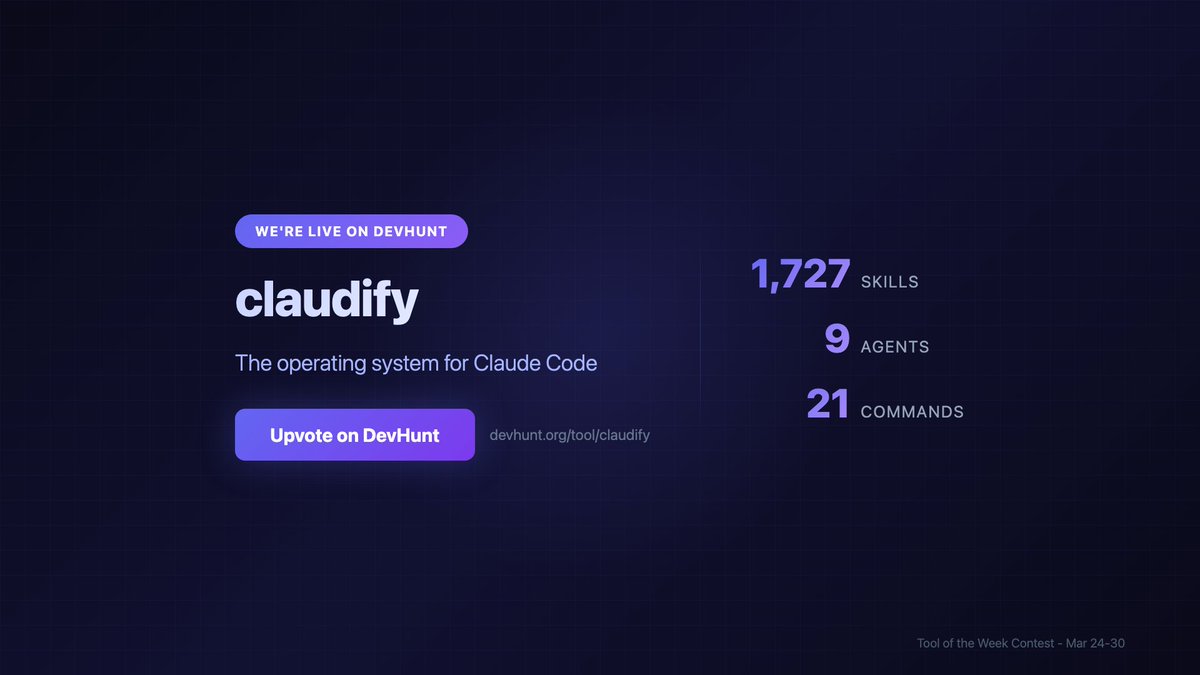
Claudify by claudify.tech is a production-grade operating system for Claude Code! ⇨ Build faster with 1,727 skills, specialist agents, and layered memory that keeps work consistent! Learn more: devhunt.org/tool/claudify
👋 Friends! ⏰Just 12 hours left to vote for your favorite developer tool at DevHunt. 23 amazing devtools are competing for the "Tool of The Week" title 🥇 Finalists : → Claudify.tech → NoteGpr.io → Link Grabber by @db_the_first → Format JSON Online by @formatjson75 → NanoBanana.Art Your vote is important, so don't miss out! → devhunt.org
Our new tool Claudify just launched on DevHunt! 1,727 skills. 9 agents. Persistent memory. The complete operating system for Claude Code. claudify.tech If you've tried it and it's helped your workflow, an upvote would mean a lot: devhunt.org/tool/claudify

You can now enable Claude to use your computer to complete tasks. It opens your apps, navigates your browser, fills in spreadsheets—anything you'd do sitting at your desk. Research preview in Claude Cowork and Claude Code, macOS only.

Anthropic just pulled the oldest trick in SaaS pricing. I pay $200/mo for Claude Max. My limits have been noticeably worse this past week. Now they announce 2x off-peak usage for two weeks. Sounds generous. But here’s what actually happens: limits quietly drop, a temporary 2x makes the reduced limit feel normal, the promo ends, and you’re left at a baseline lower than where you started. You just didn’t notice the downgrade because the 2x absorbed the transition. These AI plans are massively subsidized. The raw compute behind a heavy user costs multiples of the subscription price. Every move like this is the subsidy quietly correcting. Very sneaky, Anthropic.
A small thank you to everyone using Claude: We’re doubling usage outside our peak hours for the next two weeks.
A small thank you to everyone using Claude: We’re doubling usage outside our peak hours for the next two weeks.

🎶 I've been using voice mode to write much of my CLI code this last week Can't wait to hear what you think.

Voice mode is rolling out now in Claude Code. It’s live for ~5% of users today, and will be ramping through the coming weeks. You'll see a note on the welcome screen once you have access. /voice to toggle it on!

anthropic is hiring a what????


Dev Hunt @devhunt_
4K Followers 473 Following 🚀 Launch your dev tools. 🔥 Weekly competitions. 🆓 Free traffic to your tool. Led by @johnrushx Open-source alternative to PH for developers https://t.co/54NIS27Tal
hewar @hewarsaber
15K Followers 385 Following brands, websites, apps. trusted by a16z-backed teams. founder, https://t.co/fGNiDBIyuu
manpo @manpo_wang
1K Followers 1K Following Exploring new production systems for the AI era. https://t.co/5g2kTX8pvd / https://t.co/XLYZaZDnrk / https://t.co/XOrFBE43xc
Agathe Vernay @agathevry
1K Followers 1K Following Vibecoding with a cat on my keyboard https://t.co/rTbeYOO9Yo
iwhale @iwhale
138K Followers 23K Following Poramate Minsiri | WARROOM ติ๊กฟ้าทักบอกด้วยนะครับ พลังคนไทย 🇹🇭
Manome@ AI Agent 駆�... @Ma_san229
2K Followers 1K Following システム開発 業務効率化 自動化ツール制作 Codex Claude code kamui RAGアイデアソン個人部 1位 AIで遊ぶ ・SunriseAI・熊井総研 AI駆動開発・転職活動中 宇宙興味🌏️丨山梨出身 | 仕事依頼はDMへ📩
Admirim @admirim
38K Followers 972 Following Kosovo 🇽🇰 politics & FP Cited by @CNN @VOANews @RFERL @Mashable @AJEnglish @thedailybeast @elmundoes @le_parisien @berlinerzeitung @indy100 @TRTWorld
Vjosa Osmani @VjosaOsmaniPRKS
120K Followers 317 Following Sixth President of the Republic of Kosova Presidentja e gjashtë e Republikës së Kosovës

Albin Kurti @albinkurti
138K Followers 539 Following Prime Minister of the Republic of Kosova. President of @LVETEVENDOSJE
stshhh @Armendi
4K Followers 1K Following
Shpend Lila @Shpend_Lila
27K Followers 2K Following Global citizen. Training, Events & PR Manager @Ickosovo | Certified Marketing Executive | Communications | BP debater/judge | US Alumnus | thoughts: my own
Axhi Elban @axhiElban
475 Followers 263 Following
Fatmir Spahiu @FatmirSpahiu
23K Followers 231 Following Actor/Producer 🐘☮️✌🏻/ Veteran i te gjitha betejave te pasluftes 🇽🇰🇦🇱
Xhemajl Rexha @xhemajl_rexha
32K Followers 4K Following Freelance journalist. Chairperson of @agk_ajk Tweets about Kosovo, media, politics and football. https://t.co/4K5CsxDyY6
Kushtrim R. Krasniqi @rkushtrim
2K Followers 2K Following What do I usually do on tw? Procrastinate on important things, mostly :-( #cinephile #TechEnthusiast #ITguy #etj
Brendan Dolan-Gavitt @moyix
33K Followers 6K Following Building offsec agents: https://t.co/G9EtnC2Gl3 PGP https://t.co/3WXr0RfRkv

Talia Ringer 🕊🪬 @TaliaRinger
33K Followers 7K Following Professor, @plfmse, @IllinoisCS! Proof Automation. @SigplanM & CCF Founder. Israeli-American for peace, equality, justice. Mom. They/היא, ND, bi


AK @_akhaliq
505K Followers 3K Following AI research paper tweets, ML @Gradio (acq. by @HuggingFace 🤗) dm for promo ,submit papers here: https://t.co/UzmYN5XOCi
François Chollet @fchollet
695K Followers 825 Following Co-founder @ndea. Co-founder @arcprize. Creator of Keras and ARC-AGI. Author of 'Deep Learning with Python'.
Yann LeCun @ylecun
1.2M Followers 787 Following Professor at NYU & Executive Chairman at AMI Labs. Ex-Chief AI Scientist at Meta. Researcher in AI, Machine Learning, Robotics, etc. ACM Turing Award Laureate.
Paul Graham @paulg
3.3M Followers 791 Following
Riley Goodside @goodside
212K Followers 3K Following Screenshots of chatbots since 2022. Formerly: Google DeepMind, Scale.
betim @betimdrenica
3K Followers 950 Following Currently building messaging (multi-channel) platform at Sent - https://t.co/UsjI3IaMdt. Experimenting https://t.co/hxkJrsTWER
Rohan Bavishi @code_monet
612 Followers 201 Following Code @ Anthropic. Previously Amazon AGI Autonomy, @AdeptAILabs. Ph.D. @Berkeley_EECS. Undergrad @IITKanpur.
Ye-ho-SHU-a (phonetic... @AnalyticsNinja
10K Followers 729 Following My views do represent the views of my employer. Hippie Orthodox Rabbi father of 5. Wannabe Co-Author: Analytics Banquet.

Michael Girdley @girdley
260K Followers 3K Following Starting businesses is my business. Current Passion Project: explaining why 500+ great companies failed (100 videos so far).
Lily Lyman @lilylyman
3K Followers 2K Following General Partner @UnderscoreVC | Seed B2B. Prev growth @facebook. all about people. mama to 👶👶👶
Alex Garcia 🔍 @alexgarcia_atx
195K Followers 743 Following Building the best content studio for brands @theHODstudio | Sweat Equity Pod | Co-Founder of Cut30
Karl Wirth @wirthkarl
849 Followers 105 Following Co-founder/CEO of @nimbalyst the visual workspace for building with Claude Code & Codex. Founder/CEO of Evergage (exited to CRM). Husband, Father, Catholic.

Michael / slashdev.io @slashdevhq
9K Followers 3K Following 🇺🇸/🇸🇪 CEO @slashdev_io • AI First Software 🛠️ Claude + OpenClaw Agent Swarms 💻 React/Laravel/Fullstack/Mobile/CRM & Content Automation 📲
devtooligan (ai arc) @devtooligan
10K Followers 1K Following Resident @yAuditDAO 🤓 Building @zerocool_ai 🥶 CTO @round_ai_media 👁️ LSR @Spearbit 🧐 ETHSecurity Badge #51 @thedaofund
SunSec @1nf0s3cpt
14K Followers 1K Following CISO @xrexinc | Founder @DeFiHackLabs Web3 Security Community | AiSec Labs | Contributor @SEAL_911

pashov @pashov
42K Followers 2K Following Telegram https://t.co/qOHEkyaNYl Security audits @PashovAuditGrp Angel investing @PashovCapital
Code4rena @code4rena
41K Followers 547 Following Web3 security, on demand. $20M+ in rewards paid. 1600+ High Severity vulns found. Zero platform fees.
Patrick Collins @PatrickAlphaC
114K Followers 5K Following Co-founder of 🛡️@cyfrin | 🟪 @soloditofficial | 🦅 @codehawks | 🎓 @cyfrinupdraft | ⚔️ @battlechain
obront | eth/acc @zachobront
16K Followers 2K Following cofounder @etherealize_io // prev @scribemediaco
Immunefi @immunefi
75K Followers 641 Following Immunefi is the leading security platform for blockchains. Over $180B of user funds protected across 650+ protocols.
TrustSec @TrustSecAudits
24K Followers 492 Following Web3 security boutique, founded by @trust__90. Audits (150+), Partnerships (10+), Bug Bounties ($600k+), securing on-chain ecosystems one bug at a time.
Jackson @sjkelleyjr
9K Followers 87 Following engineering leader @RobinhoodApp | ex-@AmazonAlexa | protected billions in value at @SecurityOak, @yAuditDAO, and more | lackadaisical angel investor
tonis @totovoto
724 Followers 293 Following Rust, TypeScript, Claude Code, Kubernetes, Bare metal building: https://t.co/lgCQjUKfDu - Business Ideas https://t.co/w85v1I4o0v - Agent Orchestrator https://t.co/hlx6KZI6HI - tech job board
Anthony Morris ツ @amorriscode
31K Followers 2K Following claude code @anthropicAI | ex @stripe → https://t.co/AjndW0qdf0
Francois Laberge @seflless
4K Followers 2K Following Founder Decode. Building the whiteboard for you & your coding agents.
Daniel Tenner @swombat
19K Followers 1K Following Built a £4M/50ppl company from 0 to self-managing freedom These days, mostly AI coding with Claude Code, Cursor, etc. 🇪🇺 Eu/accYou might like