
Phuong Le @func25
Software Engineer @VictoriaMetrics, building VictoriaLogs blog.devtrovert.com Joined August 2014-
Tweets1K
-
Followers8K
-
Following123
-
Likes5K
@SoloCr33d Yes: bytesizego.com/books/anatomy-…. Feel free to reach out if you haven't received the latest version.
Chapter 8 of The Anatomy of Go is now available. It discusses channels, timers, concurrency, goroutine creation and lifecycle, runtime startup, preemption, scheduling, I/O handling, the system monitor... and a bunch of other things. The book is now complete at 873 pages, and early access will be closing soon after the editing phase, (which may add a few more pages). As usual, here is an excerpt:


If your are interested in why VictoriaLogs is so efficient and fast, then take a look into these slides about VictoriaLogs architecture internals - docs.google.com/presentation/d…
Enums are good. I wish Go supported "real" enums. But union types are not, at least IMO. At the very least, I do not want union types in a TypeScript-ish form: func F(x int | string | []byte | io.Reader) { ... } This function accepts many unrelated shapes of input. Inside the function, you must figure out which one you got. It's never good to be too convenient. It loosens the language in a way that makes APIs harder to reason about. If Go somehow were to add union types, a more Go-ish version would be: type ParseResult[T] union { Ok(T) Err(error) } type Shape union { Circle(radius float64) Rect(width, height float64) } That is closer to an enum with payloads, or a sum type or tagged union or Rust-style enums. It keeps the set of cases closed and explicit. Go does not need "any value can be A or B or C" union types. Go would benefit from "this domain value has one of these known variants" sum types. You cannot pass values like in TypeScript: f(123) f("hello") You need to pass explicit variants instead, assuming Input is a tagged union: f(Input.Number(123)) f(Input.Text("hello")) More verbose but safer and stricter. See more at github.com/golang/go/issu… github.com/golang/go/issu…

hot take: Go would be the greatest programming language on earth if it had enums and union types. they simplified their way into having to do really weird stuff just to represent reality. you should still probably use it though.

"We weren't gambling on a new technology — we were promoting one we'd already been operating in production against our own workload, and that consistently outperformed Loki in our side-by-side testing on the kinds of queries we and our users actually run."

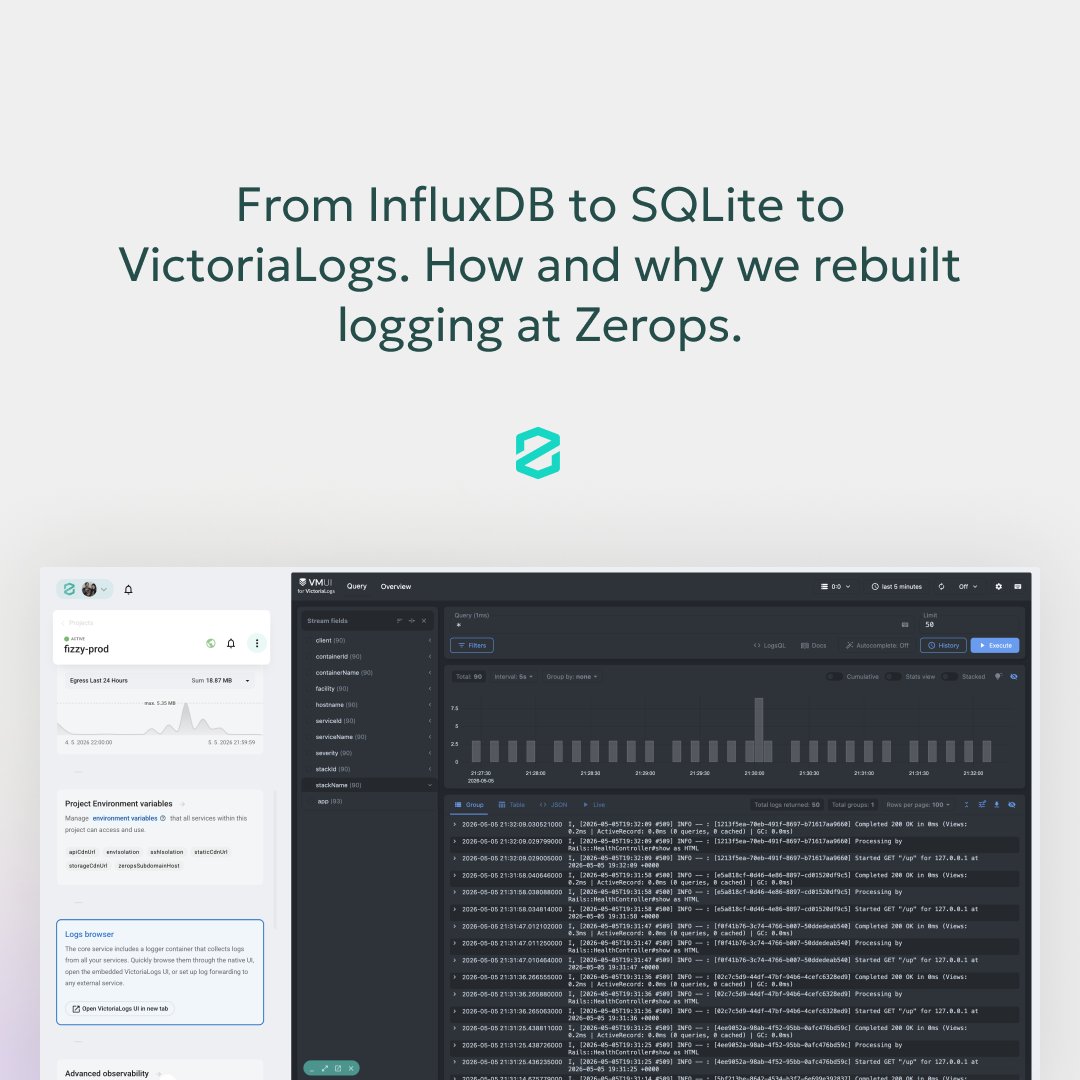
The dedicated logger service inside every Zerops project is now using VictoriaLogs. - 100x more log retention - 3x faster queries - VictoriaLogs UI embedded into Zerops - Already rolled out to every existing project Full story below.

Something is seriously wrong with how people contribute to open source these days. People submit AI-generated code they clearly don't understand. When reviewers comment, they feed it back to the AI and submit again. The loop never ends. Low-effort PR requires extremely high effort to review. That math is never fair. You think this is how you build a reputation in open source? No, no, and no. You're just burning out maintainers. --- Use AI to understand the codebase instead. Ask it to explain things. Build your own judgment. It's ok to use AI as a tool for coding, but make sure you filter out any AI slop before submitting. You gain the skills. You gain the reputation. The project actually benefits. Is it that hard?
Code is becoming cheaper than ever, but maintainability is becoming more expensive than ever.
@HSVSphere @JustDeezGuy Fair enough, skill issue
@HSVSphere @JustDeezGuy Because you don't need that level of concurrency abstraction most of the time. context, waitgroup, errgroup, clear ownership patterns cover many common cases well
@raghavan_srini Agreed, though most backend systems people build aren't mission-critical at that level. Go ofc can, it just shifts responsibility to developers or to higher-level tooling
Go is not bad at concurrency. A more factual take is Go is excellent at making concurrency cheap, explicit, and approachable (and approachable, and approachable), especially for common backend patterns. But Go gives you relatively low-level primitives, a lot of correctness around cancellation, task lifetimes, cleanup, error propagation, and backpressure is left to us, the programmer. So the fair comparison is not "Go vs JVM, who wins?" It is: Go optimizes for simple pragmatic concurrency, the modern JVM ecosystem has stronger tools for structured and resource-safe concurrency. Which one is better depends on how complex the concurrency problem is. This is just a "depends on the problem" discussion.

Generally developers think of Go as being great for concurrency. Its not. JVM approaches are vastly superior. And even some of the best in the whole industry when you include virtual threads, structured concurrency & Effects.
@turbofish_pk I'm waiting right along with you :) It's currently going through an audit but I'm expecting it to be out sometime this month
@rahulyadavsep92 @sanskarpan It depends on the editor, but I expect it to be released this month
Go is simple, so I ended up writing an 865-page book about how it works internally, just to see how it maintains that simplicity 😇
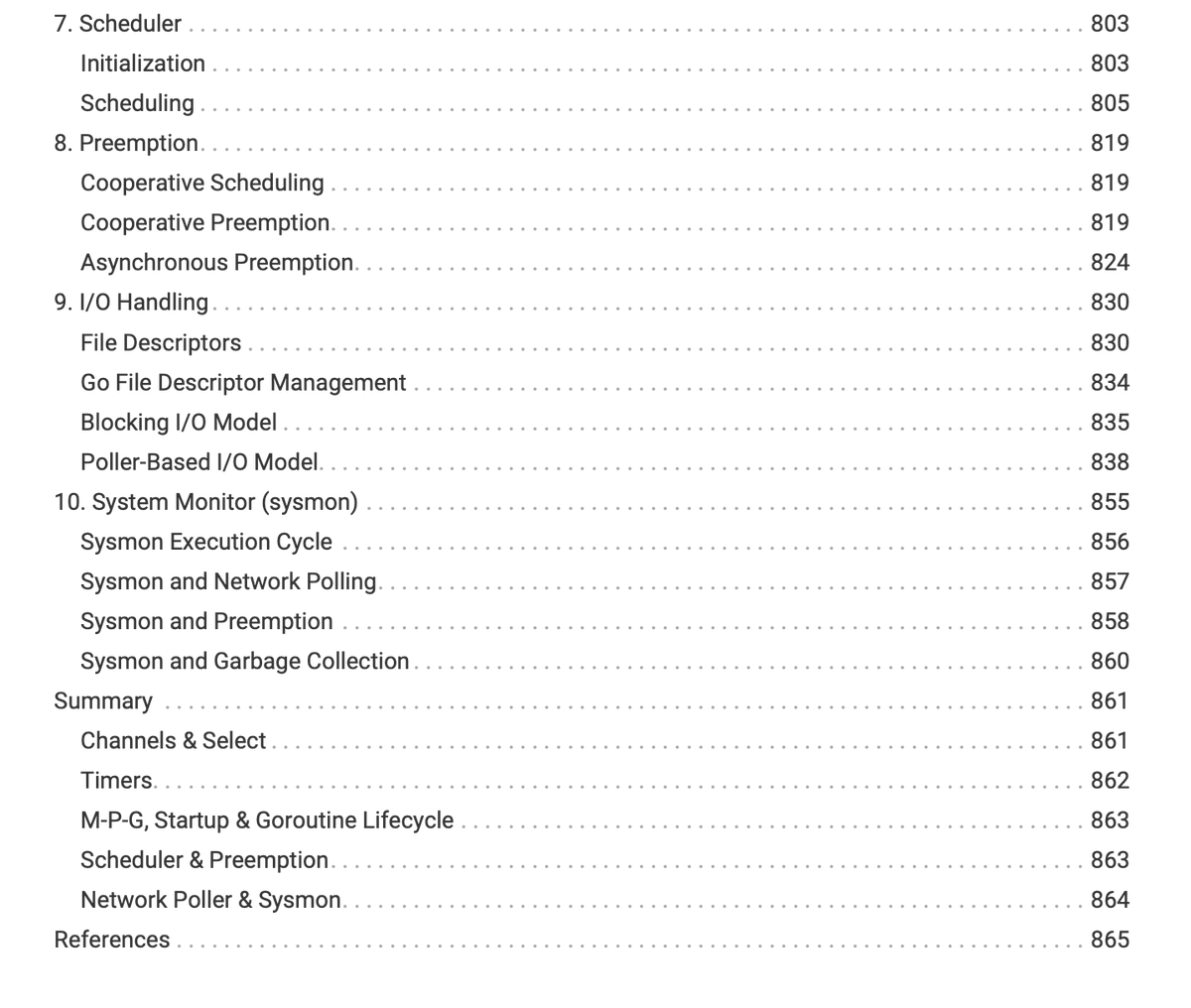
@rahulyadavsep92 @sanskarpan That's weird, it should be 7 chapters, could you help @MattJamesBoyle?
@nowgoo I will try to push it in a couple of weeks
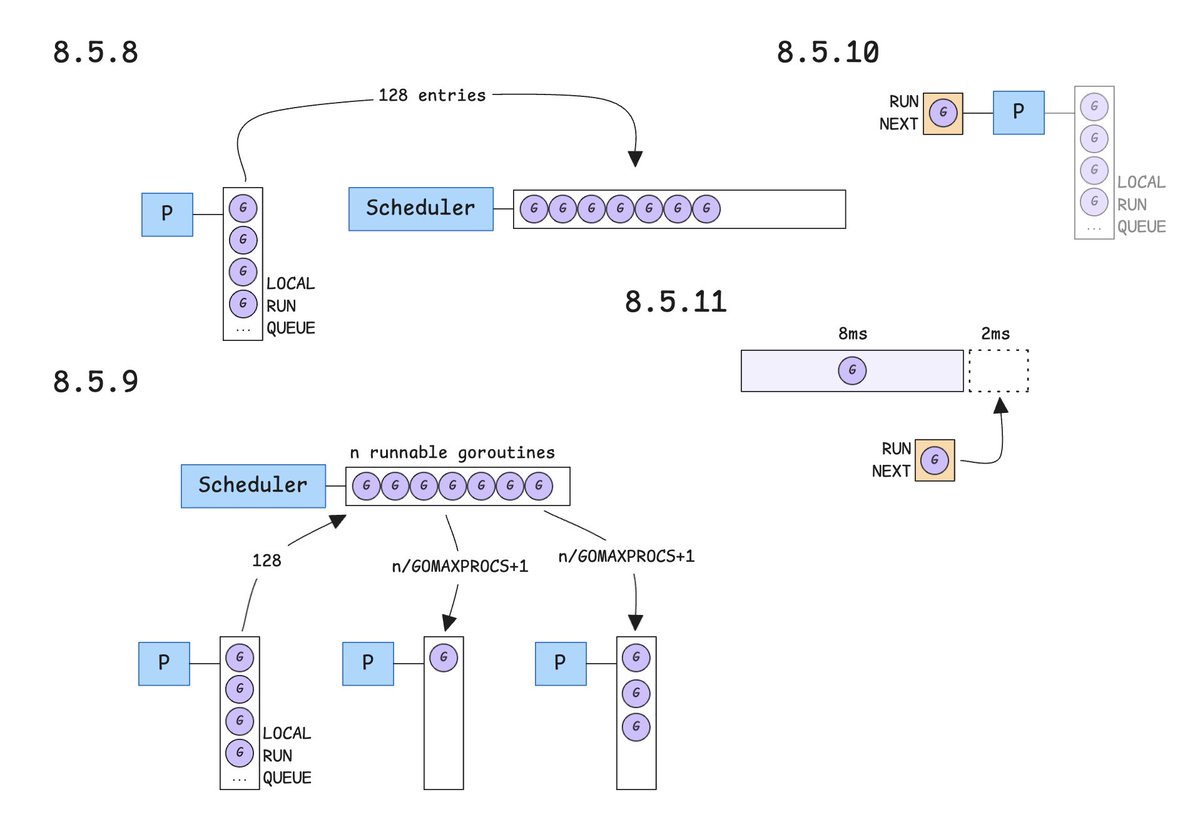
Chapter 8 of The Anatomy of Go is ready for review. It goes into concurrency, the Go scheduler, threads, the system monitor thread, goroutine preemption, what happens at startup, how channels work, how the select statement works, and how timers work behind the scenes, a lot and a lot, with visual explanations. This is the final chapter, it is near the end of the journey.

Who's the biggest Victoria-stack bull in my feed that wants to say why they love it? I'm yolo porting from Prom/Loki etc in a project because I saw some nice numbers in the past and want to try it out but want to hear some people that are excited by it geuinely
@mrkaran_ @techsutra @VictoriaMetrics I'm from the VictoriaLogs dev team, let me know if you need any help
@stuckinforloop @MattJamesBoyle could you help?
@Srishailam_D No, only one time, you will have full

Gaurav joshi @Gaurav01121992
10 Followers 485 Following Frontend engineer love to know more about web related stuff.

Santha Kumar @snowpada
4 Followers 39 Following


MIHIR @mkrath021
157 Followers 2K Following A tough guy.. ready to accept any chalenge... #Brahman #hindu #Sanatana_Dharma
Prasad Gaikwad @PrasadGaikwad
124 Followers 925 Following Software Engineer, developing cyber security softwares!

Christian Amaonwu @camability
105 Followers 62 Following Software Engineer, Blockchain Curiosity Engineer, Solving technical problems for a living..., Long Distance Driving as a hobby, Pro-Quiet
kbi @bi_kev
14 Followers 90 Following
Rohit @that_rohit
28 Followers 523 Following
Arbashu @camph0rr
12 Followers 57 Following
dostoevsky @vishaljx_
51 Followers 452 Following Building https://t.co/Ra3MIa5LSK • Loves Reading • Part-time musician
Anonymous @ramnaresh851
46 Followers 387 Following
aji @zqwirp
5 Followers 249 Following
Neetiman Kar @k_neetiman
0 Followers 169 Following
Akshay @typeangled
457 Followers 903 Following I love Ruby on Rails. I run a software consultancy and write about Rails on my blog.
Arkfile @Arkfile_OSP
141 Followers 603 Following Secure, encrypted file storage, backup & sharing. | Private File Vault over S3 | FOSS | e2ee | BTC + XMR | Beta: https://t.co/6VCPwdzeoi



ilovedatabase @ilovedatabase
15 Followers 862 Following

Afshin @__afshin
6 Followers 127 Following

Ajinkya Dhomne @Ajink5
6 Followers 64 Following
Rafael Oliveira @rafaell88
37 Followers 179 Following

Prithvi Anil Kumar @jesusinsnkrz
53 Followers 622 Following I'd rather not talk about it, just do that shit. engineering @ CRED
S A @flafee_fluff
0 Followers 3K Following Tesla, Grok 4, and X fan. Goal: Become an X engineer. ♥️♥️ 🇮🇱 🇺🇸 ♥️♥️ Israel 💪💪

KingStexx @kingstexx
95 Followers 3K Following Learning Addict. jit(jacfwd(jacrev(fun))). Loves Americana 🇺🇸
maxim satanov @eightuponatime
7 Followers 55 Following a promising ant watcher. it took me 8 years to get my bachelor's degree. PL i know: 1)LG washing machine; 2)tasm.
たん @hametsuno
351 Followers 321 Following 国立大→小学校教員→エンジニア(Go, Typescript, Terraform 等)趣味やキャリアのため Tech 関連の知識を集めるのが好き。2025 AWS All Certs
Ben Dicken @BenjDicken
35K Followers 838 Following databases → @planetscale videos → https://t.co/J5soMyfENa writing → https://t.co/YpfkF0JIKG

leo @leonidasmv
440 Followers 1K Following

Thibaut Freedisch @freedisch
290 Followers 270 Following Backend Engineer • write on Distributed Systems & Kubernetes ex. @OWASP • Google Summer of Code '24


N @NS18091995
102 Followers 1K Following
Ricardo Buera @ricardo_buera
5 Followers 2K Following
Craig Certo @craig_certo
56 Followers 131 Following Senior Engineer @ https://t.co/Ak31Cqs5F9 Founder @ https://t.co/MpILg0cqmO Founder @ https://t.co/KDvbQr5563


Marc Frei @marcfrei
51 Followers 2K Following https://t.co/n6FT1vsqXS • https://t.co/ogGV4ZlrYQ Also @[email protected]
GitHub Status @githubstatus
110K Followers 1 Following
HeyGen @HeyGen
104K Followers 174 Following Turn ideas into professional videos in minutes. #1 on G2 for Most Realistic AI Avatars. Try it for free at https://t.co/xhvVUYZXQ2
mem0 @mem0ai
18K Followers 21 Following Memory Layer for your AI agents. Open source: https://t.co/HqLHhUMUpN



Roy @im_roy_lee
197K Followers 2K Following ceo @cluely | kicked out of columbia, harvard, community college graduate
Benji Taylor @benjitaylor
137K Followers 447 Following leading design @x/@xai. prev. head of design @base. founder @family (acq by @aave). tools @dip.
Google Site Reliabili... @googlesre
16K Followers 8 Following ⌨️🛠️📊 #SRE resources from the @Google Site Reliability Engineering team.
Shopify Engineering @ShopifyEng
58K Followers 709 Following Making commerce better for everyone. Follow us for technical discussions and updates on how engineers build @Shopify. Explore open roles: https://t.co/NFSvvCJBXt
Pinterest Engineering @PinterestEng
14K Followers 36 Following We're the engineers behind Pinterest, building a visual discovery engine powered by the latest in machine learning, 300+ billion ideas and 500+ million users.
Ben Eater @beneater
25K Followers 78 Following Scaling education somehow. Formerly @khanacademy. Now making things at https://t.co/O7StbNzWXo, https://t.co/wxK2GObTmU, and sometimes https://t.co/hZEJcP4Lr9
Airbnb Engineering @AirbnbEng
53K Followers 219 Following Creative engineers building a world where you can belong anywhere.
Meta for Developers @MetaforDevs
320K Followers 89 Following Build the future and scale with us by leveraging advanced tools and technologies, from AI to MR.

Engineering at Meta @Meta_Engineers
214K Followers 197 Following Engineering at Meta is a technical news resource for engineers interested in how we solve large-scale technical challenges at Meta.
Spotify Engineering @SpotifyEng
39K Followers 107 Following The official account for Spotify Engineering
Uber Engineering @UberEng
59K Followers 5K Following Engineering @Uber, from practice to people. https://t.co/iIenzuSNxH ✨
Ben Dicken @BenjDicken
35K Followers 838 Following databases → @planetscale videos → https://t.co/J5soMyfENa writing → https://t.co/YpfkF0JIKG
Jesús Espino @jespinog
2K Followers 768 Following Open Source enthusiast. Public Speaker. Working at @ona_hq. Blog: https://t.co/j3Rl2EHXuY
mattn @mattn_jp
48K Followers 3K Following Long-time #Golang user&contributor, @GoogleDevExpert Go, #Vim, #Windows hacker, ex-GitHubStars, #runner. https://t.co/t2LBoi4Gu9 発言はほぼ冗談です
Jayice @JayiceZz
641 Followers 332 Following 🚀Database & Storage Engineer|Love Photography📷| I work @VictoriaMetrics



Justin Skycak @justinskycak
43K Followers 199 Following Chief Quant @_MathAcademy_ Max-efficiency learning in hierarchical domains Expert systems + knowledge graphs All inquiries → https://t.co/zEzvSCQDsT
Raul Junco @RaulJuncoV
47K Followers 508 Following System Design made me a better engineer. Now I help others do the same. System Design • Backend • Databases • Scalability • AI
Branko @brankopetric00
19K Followers 648 Following https://t.co/XOkr99hfdO https://t.co/W9mY14IyJC https://t.co/6OAAe7iUZs
Google Antigravity @antigravity
167K Followers 14 Following An agentic development platform evolving the IDE into the agent-first era @GoogleDeepMind
Bryan Johnson @bryan_johnson
1.3M Followers 712 Following Conquering death will be humanity’s greatest achievement.
Google for Developers @googledevs
2.6M Followers 313 Following Discover the latest developer tools, resources, events, and announcements to help you build smarter, ship faster. 🚀

Arpit Bhayani @arpit_bhayani
122K Followers 1K Following ape • Principal Engineer II - AI @Razorpay • databases • ex-staff @googlecloud (memorystore, dataproc) • @TheDiceDB • 1x founder • prev @unacademy, amazon
Lee Robinson @leerob
255K Followers 798 Following Teaching developers @cursor_ai, previously @vercel

Anthropic @AnthropicAI
1.3M Followers 36 Following We're an AI safety and research company that builds reliable, interpretable, and steerable AI systems. Talk to our AI assistant @claudeai on https://t.co/FhDI3KQh0n.
Claude @claudeai
1.4M Followers 2 Following Claude is an AI assistant built by @anthropicai to be safe, accurate, and secure. Talk to Claude on https://t.co/ZhTwG8d1e5 or download the app.
OpenAI Developers @OpenAIDevs
350K Followers 1 Following Official updates for developers building with Codex & the OpenAI Platform • Service status: https://t.co/kZwnwdYYEq
Valentin Deleplace @val_deleplace
2K Followers 507 Following Engineer on cloudy things at Google. @[email protected] 💙 Serverless, QR codes, ≡Go. https://t.co/oH541S5xqu Try https://t.co/qJd5LQiKaZ 📱➡️💻
Bricks @bricksdept
7K Followers 125 Following Teaching you how to edit like the pros ⊛ Worked with @logitech, @elgato, @microsoft & @raycast ⊛ Join Waitlist → https://t.co/wWusuVaJ6f 🕷️
PVLDB @pvldb
6K Followers 10 Following The Proceedings of the VLDB Endowment (PVLDB) RSS Feed: https://t.co/5wEKOfq2OD Bluesky: https://t.co/jULSIiQ5M3
Interesting AF @interesting_aIl
2.6M Followers 113 Following Posting interesting history, tech, art, and more. 📧 submit clips & inquiries to [email protected]
Anton Zhiyanov @ohmypy
8K Followers 42 Following Open source maintainer at https://t.co/lVeVYa0cGf. Author & educator at https://t.co/WIgisTWNrF
Ivan Velichko @iximiuz
74K Followers 561 Following Software Engineer. Educator. Entrepreneur. Bootstrapping https://t.co/9b6sZ2UVQj - a learning-by-doing platform to master Linux, Containers, and Kubernetes 🚀
Denys Holius 🇺🇦 @dengolius
131 Followers 256 Following I'm working on @VictoriaMetrics He/Him | tweeting my own opinions. Posting to https://t.co/z3H3Qd1ejR https://t.co/7iN7A0Aqkp
Jack Vanlightly @vanlightly
5K Followers 235 Following Likes breaking ideas and systems, writing, picking systems apart @confluentinc Ex @Splunk, @VMware https://t.co/voJWmL5iBE Credit: ESO/B. Tafreshi
Life Doctor @LifeDoctor247
184K Followers 104 Following Neck Pain | Rehab 🦸♂️ Body Pain & Relief Tips Everyday! Pain? Do this... 💆♂️
Jiekun @ReadTheDuck
494 Followers 55 Following Coding @VictoriaMetrics. Learning Observability. I contribute bugs to VictoriaMetrics.
Level Up Coding @LevelUpCoding_
10K Followers 2 Following Helping you become a great engineer. System design made simple.
GopherCon @GopherCon
24K Followers 96 Following The premier gathering of Go enthusiasts will convene at the Seattle Convention Center | Summit from August 3rd - 6th. Grab a pass & join us in the Emerald City!You might like